
By failing to prepare, you are preparing to fail – Benjamin Franklin
Crash Course
🤝 Quick Intro 🤝
This course is for people who just lost their cat or want the cliff notes. You should still read the full Lost Cat Guide to make sure you don’t miss any crucial tips.
Always free. No ads. No credit card ever.
🐈 Cats allowed to go outside 🐈
If your cat is ever allowed outdoors (even occasionally), your recovery strategy is different.
View “Cats With Outside Access”
😻 Biggest factor is personality 😾
Start by identifying your cat’s behavior type. This will determine how you search and where you focus your efforts.
Follow the starting steps below in order—this is exactly how I approach cases.
If you’re in Hamilton County, Indiana: I will design a custom flyer and stop sign poster for you.
🐾 Curious Cats
Bold, adventurous, and often visible. These cats travel farther than most.
Design, print, and distribute flyers immediately within a 500-foot radius
Place signage on nearby stop signs and neighborhood entrances
Post on social media to expand reach
Search at all hours within 500 feet of the escape point, then expand outward
🐾 Cautious Cats
Reserved but curious. Typically hide during the day and move at night.
Design, print, and distribute flyers within a 250-foot radius
Place signage on stop signs
Focus your search within 250 feet of the escape point
Speak with neighbors who have outdoor cameras and ask them to check footage daily
🐾 Careful Cats
Hesitant around people but comfortable in familiar environments. Tend to hide first, then move at night.
Conduct an intensive search within 250 feet of the escape point
Focus on: under decks, sheds, outdoor furniture, crawlspaces, and tight hiding spots
Design, print, and distribute flyers within a 250-foot radius
Place signage on stop signs
Ask neighbors with cameras to review footage daily
🐾 Skittish Cats
Extremely fearful. These cats hide immediately and usually stay very close.
Search within 100 feet of the escape point like you’re looking for an escaped convict
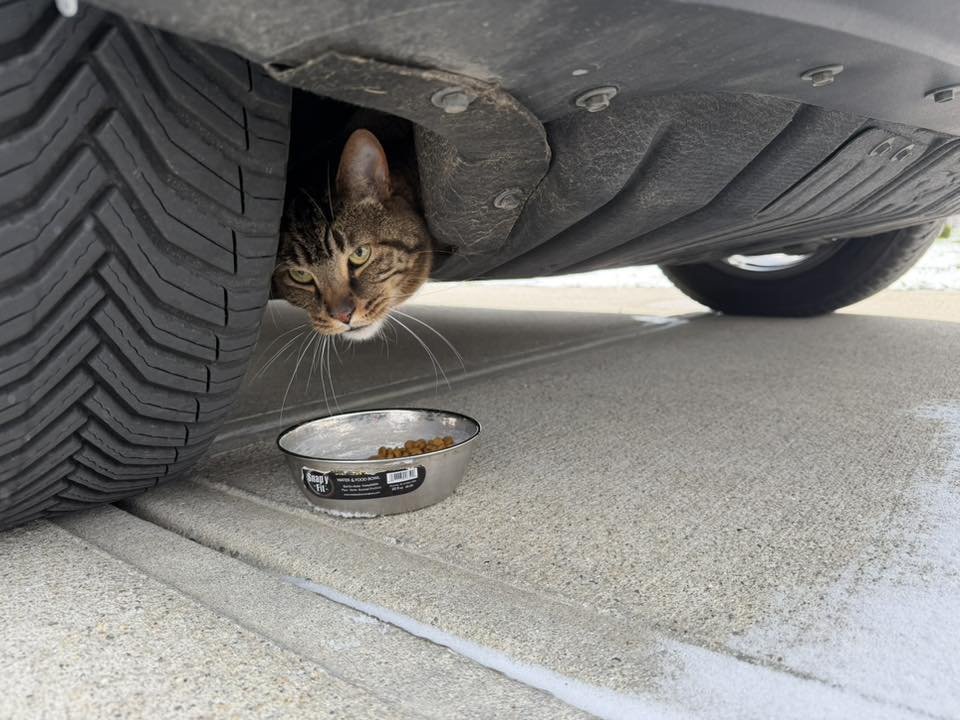
Check every possible hiding spot: decks, sheds, bushes, vehicles, and crawlspaces
Repeat intensive searches within 250 feet—most are found in this range
Design, print, and distribute flyers within a 250-foot radius
Place signage on stop signs
🐾 Should I put out used litter or the litter box? 🐾
Absolutely not. This is one of the most harmful myths out there.
Cats instinctively hide their waste to protect themselves. Putting used litter outside can attract predators and other cats, which may actually scare your cat away or prevent them from coming home.
Use worn clothing or bedding instead. Your scent is powerful and comforting to your cat—it’s the best thing to leave out.
Unfortunately, a lot of advice online is blindly repeated without experience or critical thinking. This one in particular has caused more harm than good.
Find out more here.
💰 Is a reward a good idea? 💰
No, do not offer a reward. Large cash rewards can attract scammers or people who might try to exploit the situation. That’s not who you want involved in your cat’s recovery.
Instead, if you it would make you feel better, I suggest offering a modest incentive—$25 or $50—for a confirmed photo of your cat. A picture gives you proof, allows you to track their location and helps you know where to set a feeding station or trap.
🏠 Searching your home 🏠
Do a slow, methodical sweep: closets, appliances, mattresses, box springs, duct chases, ceilings, rafters, couch linings. Cats turn up in wild places. I have had numerous cats found safely in their own homes.
Find out more here.
🍚 Setting a home base 🍚
What: Dry food (in front of a camera only) + water + worn clothing clustered together.
Where: Ideally at the escape point and in front of a camera.
When: Check through the night and between 4:00–6:00 a.m. for several mornings (and longer if you can). If no camera, get up to check manually.
Coyotes nearby? Don’t leave food out—it can attract them.
If you do set food down, place it in front of a camera so you can see exactly what’s visiting.
Worn clothing works best. Your scent is powerful to your cat and is often all you need.
Don’t worry if raccoons or possums stop by—they won’t bother your cat.
If several days pass with no cat sightings but lots of wildlife activity, stop putting out dry food immediately.
📸 Getting a camera 📸
Do everything you can to put a camera on the escape area (borrow a trail cam, ask a friend who hunts, or buy/return within 30 days). Cats often visit at night and you’ll miss it without a camera.
If you’re in Hamilton County, Indiana: I also have trail cameras available for you to borrow.
Click here for a guide on buying a camera.
🚨 Alerting the right people 🚨
Shelter: File a lost pet report with your local Humane Society now and visit in person regularly, even if microchipped (chips can migrate or be missed).
Microchip: Call the microchip company to flag as lost and confirm contact info.
Social: Post in neighborhood/city Facebook groups and Nextdoor (avoid county-wide “catch-all” groups to reduce false sightings).
🔎 Creating a search area 🔍
Generally speaking you want to exhaust the 250 sq foot radius around your home first and then expanding it from there. An easy and free website to create that search radius is located here.
If you’re in Hamilton County, Indiana: I will create a search area for you.
📄 Design a flyer 📄
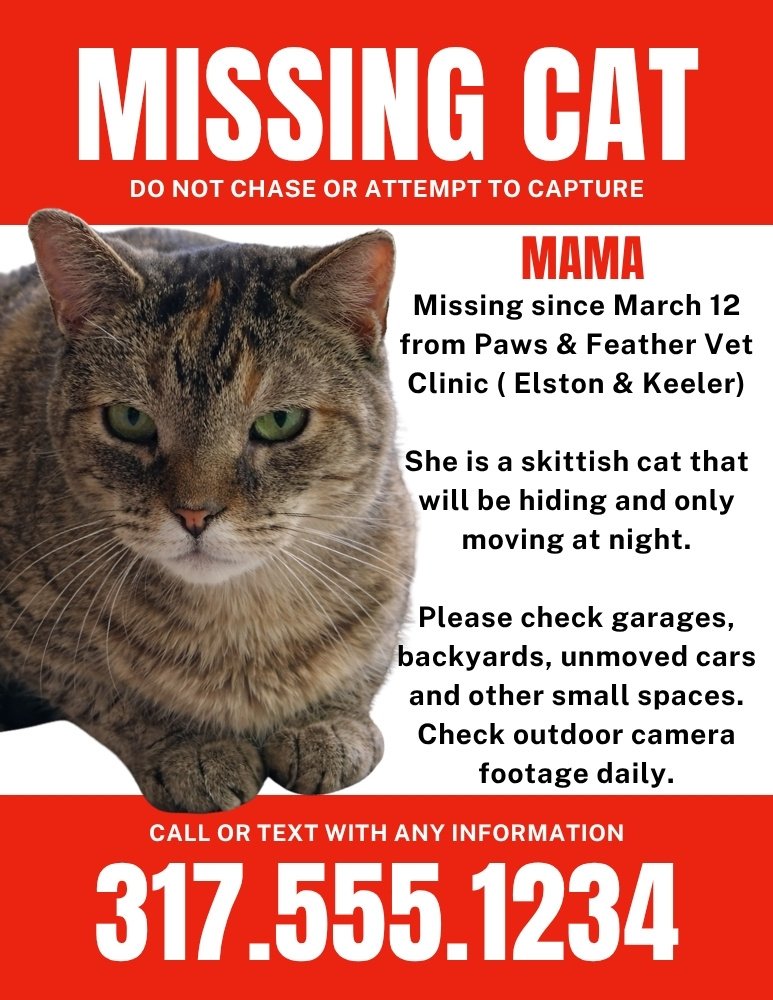
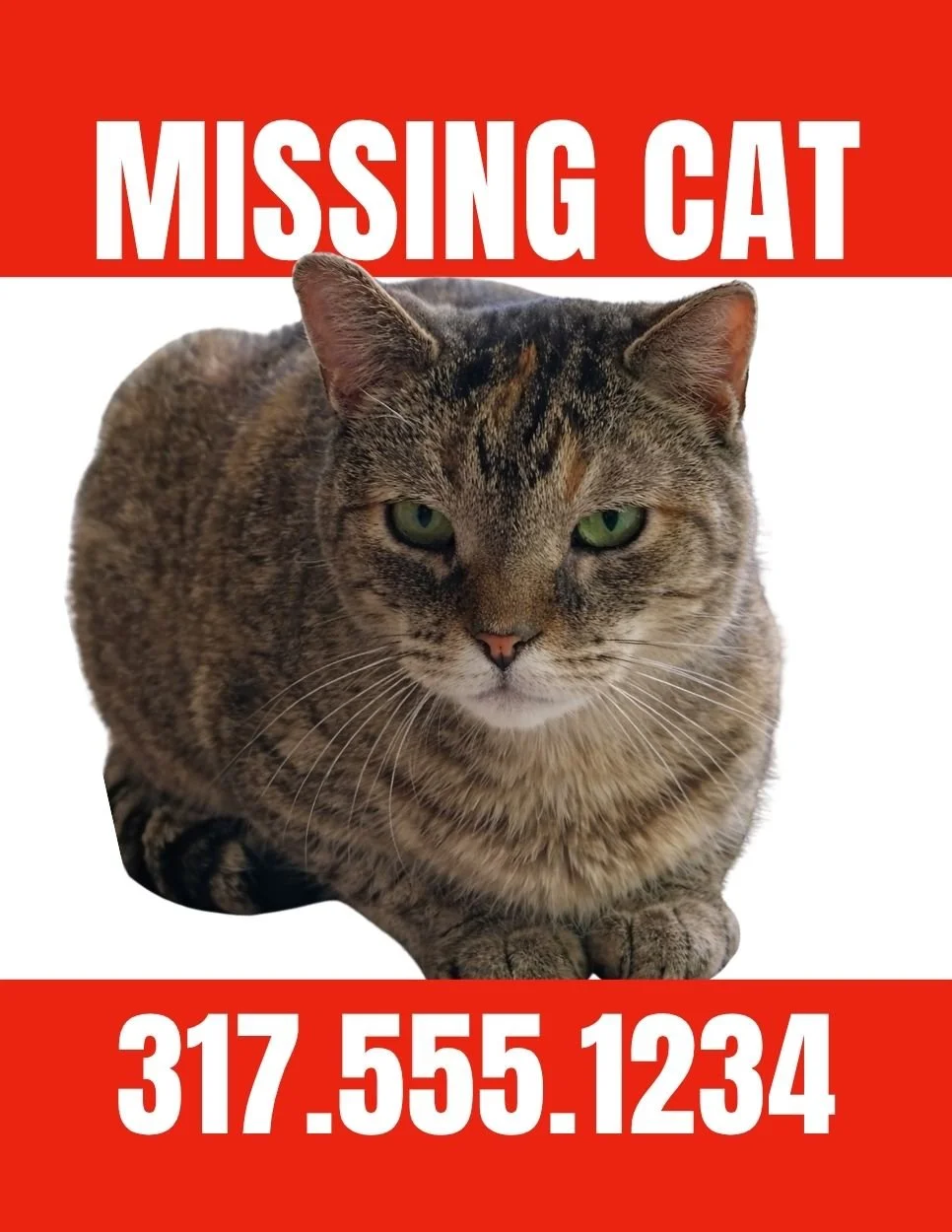
Musts: Big photo, “LOST CAT”, huge phone number.
Skip: Detailed physical descriptions and the cat’s name (strangers calling it doesn’t help).
Print: Color is ideal; black & white is fine in a pinch.
→ See: Flyer section for detailed instructions or use Canva.
If you’re in Hamilton County, Indiana: I will design a flyer for you.
📄 Design a flyer for a stop sign 📄
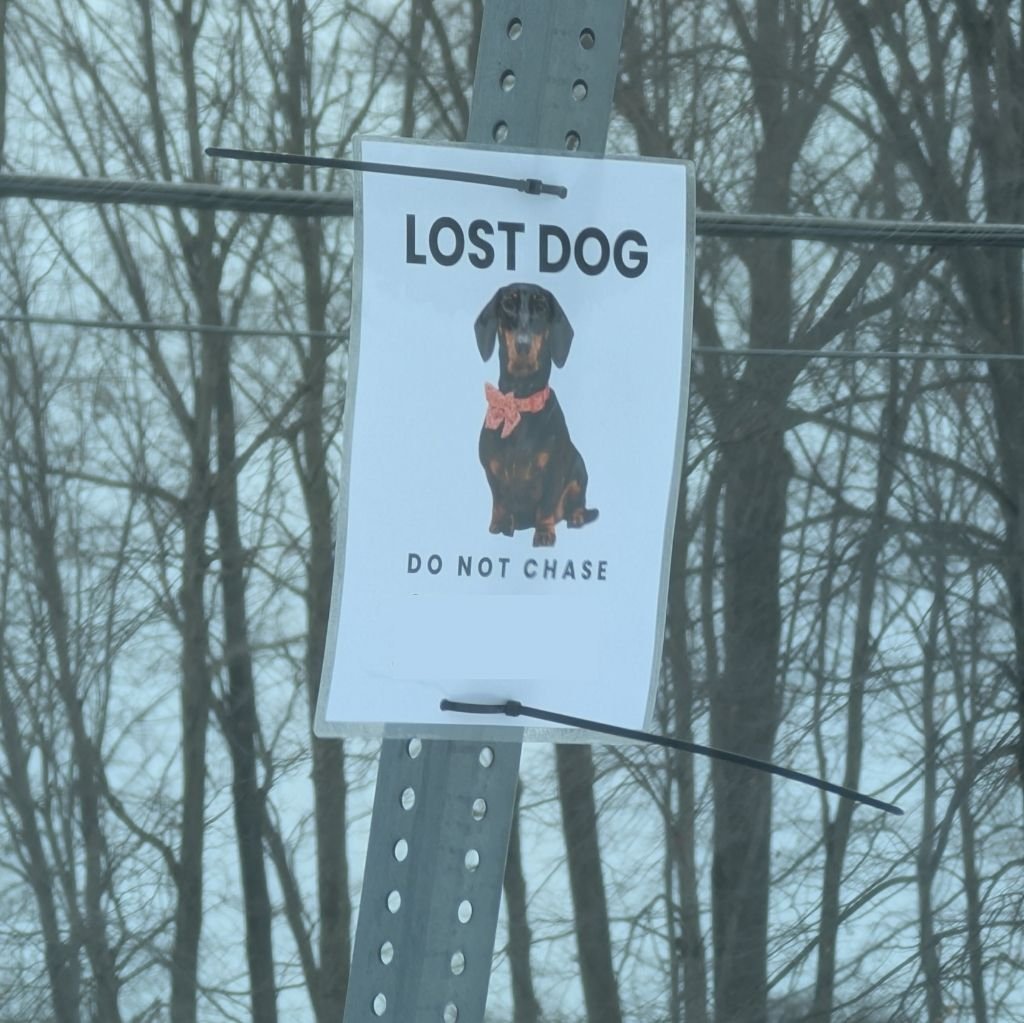
Musts: Big photo, “LOST CAT”, huge phone number. Be sure to laminate it and use zip ties to secure it to a stop sign or other road sign.
Skip: All other words as they’re difficult to read from a briefly stopped car.
Print: Color is ideal; black & white is fine in a pinch.
→ See: Flyer section for detailed instructions or use Canva.
If you’re in Hamilton County, Indiana: I will design this for you.
🙋 Meeting your neighbors 🙋
Search Close to Home
Most cats stay nearby. Focus your efforts around your home first.
While some cats may travel farther in vehicles, don’t let that distract you—start local.
Talk With Neighbors
Personal conversations work best. People are more likely to help when you’ve spoken face-to-face.
Hand them a flyer with your cat’s photo and your phone number so they know exactly how to reach you.
Use Cameras & Property Access
Ask neighbors with outdoor cameras or doorbell cams to check their footage daily.
Request permission to search their yards, sheds, and garages yourself—you’ll be more thorough than anyone else..
🌄 Searching outside 🌄
Use a Flashlight
A high-powered flashlight will reflect off your cat’s eyes—even in daylight.
Spend daylight hours talking with neighbors and searching their properties.
Use the hours between dusk and dawn for active searching—cats are most active then.
Search by Personality
Curious cats may wander where people can see them.
Skittish cats often hide nearby, frozen in fear.
Use your mapped search area and check thoroughly.
Places to Check
Under decks, porches, and sheds (get low and look carefully)
Garages (ask neighbors to open and check)
Inside and under cars (pop hoods, check wheel wells)
Crawlspaces and open basements
Bushes, hedges, and dense landscaping
Up in trees
Wood piles, construction debris, storm drains
⚠️ Tip: If a cat can fit its head into a space, it can usually fit its whole body. Think like a cat and check everywhere.
Calling Your Cat
Use your normal voice—your cat will recognize it.
Don’t rely on indoor toys or sounds; they can blend into the outside world.
🙀 Cat spotted somewhere 🙀
Has your cat popped up on camera? Read the full section over it as you don’t want to take any shortcuts.
🪤 Trapping a cat 🪤
I am very particular about trapping and will not provide an abbreviated version of this very important training. If you have time to set a trap, you have a time to learn how to do it correctly.
How to get a trap.
How to trap train a cat if needed.
✅ What’s next ✅
Be sure to take some time to read through the Lost Cat Guide. It’s still a quick read, but it goes into much more depth than what I can share here. You’re always welcome to reach out with questions from anywhere in the world—just please look through the guide first so you’re starting with the same foundation.
I know this process can feel repetitive, but persistence truly makes the difference. A group I volunteer with once reunited a cat that had been missing for two years—they found her at a feeding station just two miles from home. Cats are survivors. Please don’t give up. Keep searching for months before even thinking about calling it off.