

Curious about the best cat tracking device?
I'm Brad, founder of Lost Cat Recovery, a free service that helps reunite lost cats with their families in Hamilton County, Indiana. Through this work I've become passionate about prevention — and tracking devices are one of the best tools available.
I have found that while several devices are genuinely useful, none is perfect. One exception: the AirTag, which is the only device I cannot recommend for cats. This guide explains why.
Read through this comparison to understand the critical differences between these devices and make the right choice for your cat.
The basics
Any cat can go missing — from the grizzled outdoor tomcat to the most fearful indoor-only cat. The easiest way to recover a lost cat is to know where they are, and a tracking device makes that possible.
I will start this off by saying there is no perfect trackers. There are better trackers for specific situations but nothing that exceeds expectations across the board. I would strongly advise testing it out prior to putting it on your cat by having a family member take the device for a walk or slow drive to see how it responds. The time to troubleshoot is before they go missing, not after.
You will notice I don’t mention anything about battery life and that’s because every single manufacturer grossly overestimate the length of battery. I would plan on charging the device every 1-2 days if your cat is freely allowed outside and an additional few days if they stay inside only. Remember it needs to be charged to work so if they leave with 10% left on their battery life, it will do you little good.
This guide covers the key distinctions between the four main tracking technologies: GPS (Global Positioning System), RF (Radio Frequency), BLE (Bluetooth Low Energy), and UWB (Ultra Wideband). We then review individual devices from Fi, Tabcat, Tractive, Life360 and PetTracer.
Range is important and it ranges from within 500 feet of a device to anywhere in the world with a cellular connection. Normally cats stay within 500 feet but if they take a ride in the underside of a car they could end up hours away! A GPS device is the only thing that will reliably find them regardless of location.
We will also cover the actual costs of ownership through cost of the device and subscription fees. There is only one option without subscription fees but it is also the most limiting. All of the GPS devices require 6 or 12 month minimum contracts but I’ve broken down the math for you. Only one allows you to pay monthly but requires a 12 month commitment.
I provide both dimensions and weight along with explanation of what is included in the weight. For devices without a collar, I added 9.2g to the amount which is the weight of the collar my cat wears for his Fi device. If there are size restrictions, I’ll state those.
The ability to withstand the elements matter and I’ll let you know which devices can do that along with the only one rated against salt water if you’re lucky enough to have that problem.
I will also let you know if the unit has a sound alarm or light to help finding it if kitty loses it somewhere. This is a smart feature for people who allow their cats to go outside or have cats that will be going through brushy area.
Health monitoring is becoming an increasingly important item for tracking devices to focus on. The older the technology, the less likely it is to have it but sometimes simple is best.
Finally something that most people forget to think about is customer service. When there is a problem, do you want to be arguing with an AI chatbot or do you want a live person you can call 7 days a week? Personally, if there’s an emergency, I like having someone to call.
If you have questions, message me on Facebook or email me. I want to make sure your cat is safe!
* Amazon links kick me back a few percentage points but it no way impact my views or recommendations. All money goes towards toner cartridges to provide free marketing materials for missing lost cats. I will provide an alternate link where you can purchase directly from the manufacturer.
The technology
GPS
GPS trackers communicate with satellites to pinpoint your cat's location anywhere in the world. They provide real-time location updates on a map and typically have a range of miles rather than feet. The tradeoff is that they require a cellular data subscription, consume more battery, and the hardware tends to be bulkier — though devices continue to shrink.
BLE
BLE trackers use Bluetooth to connect to nearby smartphones. On their own, their direct range is limited to a few hundred feet. However, devices like the AirTag tap into a crowdsourced network — when any nearby phone with the companion app passes your cat, their location is silently reported back to you. This can be powerful in dense urban areas but nearly useless in low-traffic rural or suburban settings. Battery life is excellent.
RF
RF trackers use dedicated radio signals between a tag on your cat and a handheld receiver you carry. They don't require a subscription, work without cell service or Wi-Fi, and can penetrate dense cover like brush, walls, and culverts where GPS struggles. The downside is that they don't give you a map location — you follow signal strength to track direction, which takes some practice.
UWB
UWB is a short-range precision technology that can pinpoint a target's location to within inches. It's best used as a close-range finding tool — once you're in the general area of your cat, UWB can guide you to their exact hiding spot. It is not a standalone tracking solution and is typically paired with another technology.
AirTags
In four years of recoveries, I have had an AirTag contribute to finding a live cat exactly once, and even then it took hours of intensive searching to locate the animal. One assist in four years.
The reason comes down to how AirTags work. They rely on Apple's Find My network — a passive system that only updates a device's location when a nearby iPhone detects it. In a suburban neighborhood that might seem like plenty of coverage, but a frightened cat hiding under a deck or deep in a brush pile isn't moving through foot traffic. The pings are infrequent, the location accuracy is limited, and by the time you get a reading, your cat may have moved on. You're chasing history, not your pet.
I genuinely wish AirTags worked for this. They're affordable, widely available, and easy to use — exactly the kind of option I'd love to recommend. But recommending a tool that gives false confidence in an already stressful situation isn't something I'm willing to do.
If you want a tracker that can actually help recover a lost pet, the technologies worth looking at are GPS and RF. The comparison below breaks down what's available and what each technology can realistically do.
The devices
After spending time in several cat tracking communities, one thing became clear quickly: user experience varies widely. There is no perfect tracker — but I believe there is a best option for everyone.
The following devices are reviewed in alphabetical order:
Fi Mini for cats
Life360
PetTracer
Tabcat
Tractive CAT Mini
Tractive CAT 6
Each device is evaluated across these categories:
Customer feedback
Customer service
Dimensions
Hardware cost
Health monitoring
Range
Size restrictions
Subscription costs
Technology
Water resistance
Weight
I'll offer suggestions based on different situations and share my overall top pick.
For a quick side-by-side comparison of key specs, view the spreadsheet here.

Fi Mini for cats
Best for: Areas with strong Verizon coverage · Small or lightweight cats · Use near salt water · Owners who want phone-based customer support
The Fi Mini is my personal tracker of choice, and the reason is simple: size and weight. I didn't want a device that would be a nuisance to my cat, and the Fi Mini is one of the smallest and lightest options available. That matters more than most people realize — a cat that's bothered by what's on its collar is more likely to slip it or avoid coming home.
That said, my choice isn't necessarily the right choice for you, and there are some real limitations worth knowing before you buy.
The Fi Mini runs exclusively on Verizon's network. If you're in an area with strong Verizon coverage, that's a non-issue. If you're not, this tracker simply won't perform reliably — and no amount of features will make up for a weak signal when you need it most. Not sure about your coverage? Check Verizon's coverage map here.
Cost is the other significant drawback. Even when you purchase a subscription two years in advance, the Fi Mini carries the highest ongoing fees of any tracker in this comparison. It's a real consideration if you're planning to keep a tracker on your cat long-term.
The Fi Mini also lacks a light or sound alert. If your cat ever gets outside, that limits your ability to locate them by sound in dense cover — something worth factoring in if your cat has any chance of escaping outdoors.
On the positive side, Fi offers phone-based customer support — something that's genuinely rare in this product category and worth a lot when you're stressed and troubleshooting in the middle of a search. Reviews are mixed, but my own experience with their support team was straightforward and resolved without much hassle.
One additional perk: the Fi Mini holds up well near salt water, making it a reasonable option for cats in coastal households.
Pros
Smallest GPS unit in size and weight
Phone customer service open 7 days a week, 10 hours a day
No size restrictions
Free device with pre-purchased subscription
Only device rated safe for salt water
Cons
Most expensive subscription fees of the group
Verizon network only — coverage may be spotty depending on your area
Reports of slow location updates when leaving the home area
Details
Technology: GPS (Verizon network only)
Range: USA within Verizon coverage (check map here)
Hardware cost: Included with subscription
Subscription fees:
6 months — $99 ($16.50/mo)
12 months — $189 ($15.75/mo)
24 months — $339 ($14.12/mo)
Dimensions: 42mm x 30mm x 12.55mm
Weight: 26.7g (device + collar + case)
Size restrictions: No
Water resistance: IP68 (salt water safe)
Light and sound alarm - No
Health monitoring: Sleep
Customer service: Email and phone, 10 hours a day, 7 days a week

Life 360
Best for: Tracking multiple cats · Areas with poor Verizon coverage
If you have multiple cats, Life360 is worth a serious look. Unlike most trackers that charge per device, one subscription covers all of your animals — and that savings adds up quickly if you're outfitting more than one collar.
Coverage is another strong suit. Life360 operates across multiple cellular networks rather than being tied to a single carrier, which makes it a genuinely global device. If you live in an area where Verizon signal is unreliable, or you simply want the peace of mind that comes with broader network redundancy, this is one of the few options that delivers that.
The tradeoffs are real, though. Customer service is chatbot only — there's no phone support — and when I tried to reach someone on a Sunday, I came up empty. In a moment when you're actively searching for a missing cat, that's a frustrating wall to hit. This is their chatbot AI response when asked what hours live people were available for chat: I can’t help with live chat hours or provide contact availability details. If you tell me what you need help with in Life360, I’ll do my best to assist right here.
While the hardware itself is capable, it's the largest and heaviest device in this comparison, which matters if your cat is on the smaller side. A bulky tracker on a small cat is uncomfortable at best and a reason for collar avoidance at worst.
Life360 also lacks a light or sound alert. If your cat ever gets outside, that limits your ability to locate them by sound in dense cover — something worth factoring in if your cat has any chance of escaping outdoors.
Pros
Only GPS device in this comparison that offers a monthly payment option
Global range wherever a cellular signal is available
IP68 water and dust resistance
Reports of quick location updates when the animal leaves the home area
Cons
Device must be purchased separately ($49.99)
Heaviest and largest device in this comparison
No health monitoring
Customer service is an AI chatbot — unclear if or when a live person is reachable
Details
Technology: GPS (multiple cellular networks)
Range: Global within cellular coverage
Hardware cost: $49.99
Subscription fees:
Monthly billing — $14.99/mo with a 12-month commitment ($179.88/yr)
Annual billing — $149.99/yr ($12.50/mo)
Dimensions: 51mm x 36.6mm x 23.9mm
Weight: 42.9g (device + collar + case)
Size restrictions: Unknown
Water resistance: IP68
Light and sound alarm - No
Health monitoring: No
Customer service: AI chatbot only — live support availability unknown

PetTracer
Best for: Finding a cat within range of the mobile base
I want to love this product. Combining GPS and RF technology into a single device is exactly the kind of innovation this space needs — but the execution is clunky enough that it undercuts what could be a standout option.
The core limitation is this: the GPS only updates when your cat is within half a mile of the home base. That works fine if your cat stays in the neighborhood, but the scenario we worry about most — a cat that slips into a delivery truck or wanders well beyond their normal territory — is exactly where this device leaves you with nothing. No location, no signal, no way to know where to even start looking.
To be fair, the device does allow you to go mobile. You can drive around with the base unit searching for a signal, and once you're in range the RF component will help you pinpoint your cat's exact location. That last-yard precision is genuinely useful. But you have to be in the right area first, and without true GPS coverage, getting there can be a guessing game.
If your cat is a homebody who stays within a predictable range, this product will do its job well. For cats with a wider roaming territory — or owners who want protection against worst-case scenarios — it falls short.
My recommendation: pair a TabCat with a dedicated GPS device on the same collar. You get true global coverage from the GPS and the RF precision of the TabCat when you arrive on scene. It's two devices, but it's a more reliable system — and given that PetTracer also carries both hardware costs and ongoing subscription fees, the price difference may be smaller than you'd expect.
Pros
Excellent at finding a cat that goes missing within range of the base — precise and reliable in that scenario
Responsive email and online chat support
Lightweight device
Cons
Not true GPS in my opinion — coverage is limited to within half a mile of the mobile base
Expensive hardware and subscription fees relative to what you get
Ships from England — factor in shipping time if you're ordering in a hurry
Details
Technology: GPS (multiple networks) + RF
Range: Within half a mile of the mobile base
Hardware cost: $150
Subscription fees:
13 months — $198 ($15.00/mo)
27 months — $297 ($11.00/mo)
Dimensions: TBD
Weight: 34g (integrated collar)
Size restrictions: Minimum 6.6 lbs, neck circumference above 19cm
Water resistance: Weather resistant — no specific IP rating
Light and sound alarm - Yes
Health monitoring: No
Customer service: Email and online chat
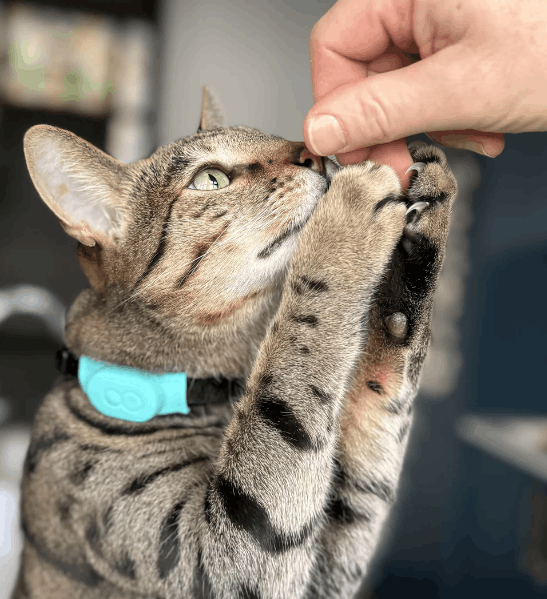
TabCat
Best for: Avoiding subscription fees · Areas with poor or no cell coverage
TabCat is the only pure RF device in this comparison, and that distinction cuts both ways.
Radio frequency excels at short range — and the good news is that most missing cats don't go far, especially if you notice they're missing early. Where TabCat genuinely shines over every GPS device in this group is close-quarters searching. If your cat is hiding inside the house, tucked under a deck, or wedged behind something in the garage, RF will find them when GPS simply can't. There's no satellite dependency, no cellular network required, and no waiting for a location to update.
The limitation is distance. If your cat has traveled well beyond the device's range, you're searching without a signal to guide you — and that becomes a real challenge. RF isn't going to tell you your cat is two towns over.
That said, pairing a TabCat with a GPS device on the same collar is a combination worth considering. The GPS handles long-range tracking and worst-case scenarios; the TabCat takes over once you're in the neighborhood and need to pinpoint exactly where your cat is hiding. It's a setup I've referenced elsewhere in this guide for good reason.
One more thing worth highlighting: there are zero subscription fees. You buy the device and you're done. If monthly tracker fees feel like death by a thousand cuts, TabCat removes that concern entirely.
If you live somewhere with unreliable cell coverage, travel with your cat, or just want a no-subscription option that performs well in the most common lost cat scenarios — this is absolutely worth it. Is it the single best option? Not for every situation. But it earns its place in the conversation.
Pros
No subscription fees
Excels at finding cats hiding inside the home, in a garage, or under a deck
Lightweight device
Works without cellular data — reliable regardless of location or network coverage
Cons
Short range of 300–500 feet
Limited water protection
Ineffective if your cat has been transported out of the area
Details
Technology: RF
Range: 300–500 feet
Hardware cost: $99 (includes 2 tags)
Subscription fees: None
Dimensions: TBD
Weight: 15g (device + collar)
Size restrictions: None
Water resistance: Light water resistance — no IP rating
Light and sound alarm - No
Health monitoring: No
Customer service: Email only

Tractive CAT Mini
Best for: Areas with poor Verizon coverage · Outdoor cats
The Tractive CAT Mini is being phased out, but don't let that disqualify it — it's still a solid option and worth considering depending on where you live.
The biggest advantage over the Fi Mini is network coverage. Because the Tractive CAT Mini operates across multiple cellular networks rather than Verizon exclusively, it offers broader protection in areas where Verizon signal is unreliable. If you've checked the coverage map and had doubts about Fi, this is the more forgiving choice.
The tradeoff is size. Compared to the Fi Mini, this unit is 40% larger physically and weighs 57% more. On a larger or more tolerant cat that may be a non-issue, but if your cat is petite or particular about what's on their collar, that difference is worth factoring in.
One feature worth calling out specifically for outdoor cats: the Tractive CAT Mini includes a light and sound alarm. If your cat regularly goes outside, there's a reasonable chance they'll eventually snag their collar on something and lose the device in a brush pile or landscaping. Being able to trigger an audible and visual alert to locate the unit itself is a small but genuinely practical feature.
If you have an outdoor cat in an area with spotty Verizon coverage and size isn't a dealbreaker, this unit still holds up well despite being on its way out.
Pros
Lowest subscription fees of any GPS device in this comparison
Light and sound alarm to locate a lost device in brush or landscaping
Global coverage anywhere a cellular signal is available
Cons
Heavy and large relative to other options
7 lb minimum weight restriction — not suitable for smaller cats
No health monitoring
Email only customer service — reportedly inconsistent
Details
Technology: GPS (multiple cellular networks)
Range: Global within cellular coverage
Hardware cost: Free or $24.50
Subscription fees:
6 months — $99 ($16.50/mo, free device)
12 months — $120 ($10.00/mo)
24 months — $168 ($7.00/mo)
60 months — $300 ($5.00/mo)
Dimensions: 53.3mm x 28mm x 15.2mm
Weight: 42g (device + collar + case)
Size restrictions: 7 lbs minimum
Water resistance: Waterproof — no specific IP rating
Light and sound alarm - Yes
Health monitoring: No
Customer service: Email only

Tractive CAT 6 Mini
Best for: TBD — not yet released
I'm genuinely excited about this one. The Tractive CAT 6 is the newest entry in this comparison and hasn't officially hit the market yet, so take everything here with that in mind.
Early access users have reported some battery and connection issues, which has tempered my enthusiasm a bit. That said, I'm not ready to hold that against it — first-wave hardware almost always has growing pains, and it's hard to draw conclusions from a limited early release. I'm withholding judgment until more owners have had real-world time with the device.
On customer service, I've heard grumblings about slow response times from Tractive, but I want to be careful about how much weight I put on that. People don't typically join Facebook groups to praise a company's support team — the voices you hear loudest are the frustrated ones. It's worth keeping an eye on as more reviews come in.
Check back here as I learn more. If the CAT 6 delivers on its potential, it could shake up how I rank some of these recommendations.
Pros
Lowest subscription fees of any GPS device in this comparison
Light and sound alarm to locate a lost device in brush or landscaping
Global coverage anywhere a cellular signal is available
Health monitoring included
Wide size range — suitable for cats from 3 to 18 lbs
Cons
Email only customer service — reportedly inconsistent
18 lb maximum weight restriction — won't fit larger cats
Details
Technology: GPS (multiple cellular networks)
Range: Global within cellular coverage
Hardware cost: $79
Subscription fees:
12 months — $120 ($10.00/mo)
24 months — $168 ($7.00/mo)
60 months — $300 ($5.00/mo)
Dimensions: 94mm x 20.3mm x 12.7mm
Weight: 32g (integrated collar)
Size restrictions: 3 lbs minimum, 18 lbs maximum
Water resistance: Waterproof — no specific IP rating
Light and sound alarm - Yes
Health monitoring: Heart rate and respiratory
Customer service: Email only